
Running Record Calculator
This education tool is used to calculate students running records instantly.
Results
Running Record Assessment Calculator Formula:
This running record allows you to record a students reading behavior as he or she reads from the book.
Use this below formula to determine the reading Assessment for a particular student/child:
Accuracy Level:
| Level | Accuracy % |
|---|---|
| Easy/Independent Level | 95 to 100% word accuracy |
| Medium/Instructional Level | 90 to 94% word accuracy |
| Hard/Difficult Level | less than 90% word accuracy |
Reading is a fundamental skill, and measuring reading ability accurately is essential for teachers and parents to support learners effectively. One of the most popular and effective tools used by educators worldwide is the running record. To make this process easier and more efficient, the Running Record Calculator has become an invaluable tool.
What Is a Running Record?
A running record is a way to record how a student reads a passage of text in real time. The reader reads aloud while the assessor listens and notes down mistakes, self-corrections, and words read correctly. It was originally developed by literacy expert Marie Clay as part of the Reading Recovery program.

The purpose of a running record is to assess:
- How accurately a student reads.
- How many errors they make.
- How often they correct themselves.
- Reading fluency (speed).
- Overall comprehension ability.
In essence, it provides a snapshot of a learner’s reading skills at a particular point in time.
Why Use a Running Record?
Running records help educators in multiple ways:
- Track Progress: They allow teachers to keep track of a student’s reading development over time.
- Identify Strengths and Weaknesses: By analyzing the errors and self-corrections, teachers can determine specific areas a student struggles with, such as phonics, vocabulary, or fluency.
- Guide Instruction: Running records inform instruction by matching readers with books that are at the right level—not too hard or too easy.
- Group Readers: Teachers can group students with similar reading levels for more effective guided reading sessions.
- Motivate Students: Reporting clear reading scores like accuracy percentage and words per minute makes goals visible and achievable for students.
In today’s classrooms, running records remain an essential formative reading assessment method for all grade levels.
Key Terms to Know in Running Records
Before diving into calculations, it’s important to understand some key terms involved in a running record:
- Running Words: The total number of words in the reading passage, excluding titles, captions, or skipped text.
- Errors: Words the student reads incorrectly (substitutions, omissions, insertions, or hesitations beyond a specific time).
- Self-Corrections: Mistakes the student notices and corrects immediately without prompting.
- Accuracy: The percentage of words read correctly.
- Error Ratio: The rate of errors relative to total words read.
- Self-Correction Rate: The ratio showing how often a student self-corrects errors.
- Words Per Minute (WPM): Reading speed calculated by dividing the total words read by the time taken, then multiplying by 60.
How to Conduct a Running Record
Conducting a running record is straightforward but requires attention to detail:
- Select the Text: Choose a passage between 100 to 300 words at the student’s instructional reading level (a challenging but manageable level).
- Prepare the Student: Explain the process—ask the student to read aloud naturally, trying their best.
- Record Reading Behavior: As the student reads, note every word read incorrectly and every self-correction.
- Time the Reading: Start a timer when the student begins reading and stop when they finish.
- Use Standard Markings: Use symbols or notes to indicate errors, self-corrections, insertions, omissions, and repetitions.
- Calculate Results: Input the data into a running record calculator or use formulas to find accuracy, error, and self-correction rates.
What Is a Running Record Calculator?
A Running Record Calculator is an online tool or app that helps automate the math behind running records. Instead of manually calculating accuracy percentage, error ratios, or words per minute, educators can enter the recorded data and instantly get precise results.
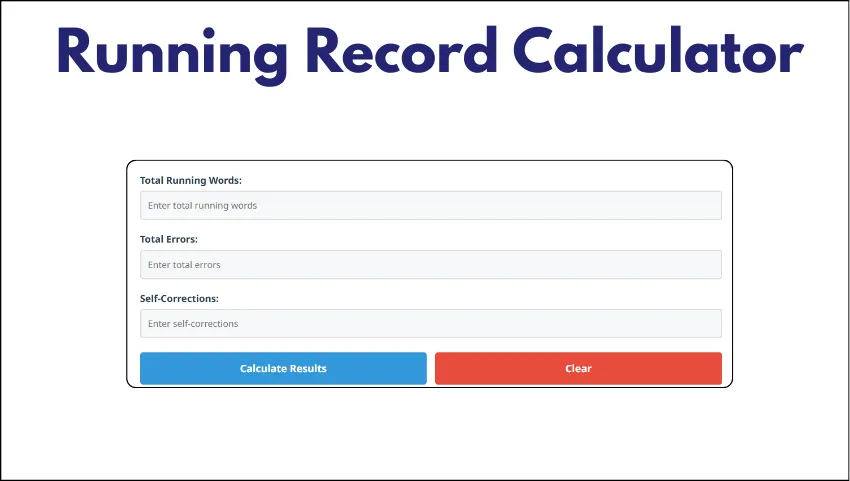
These calculators are valuable because they:
- Save time by automating complex calculations.
- Provide instant, reliable scores.
- Reduce human errors in math and data interpretation.
- Help generate reports for student progress tracking.
How to Use a Running Record Calculator
Using a running record calculator is simple. Typically, you need the following inputs:
- Total Running Words: The total words in the passage read.
- Total Errors: Number of misread or skipped words.
- Self-Corrections: Number of times the student corrected themselves.
- Reading Time: Time taken to read the passage in seconds.
Here’s how you use it:
- Start by counting words in the chosen passage (running words).
- Record errors and self-corrections during the reading.
- Measure reading time with a stopwatch or timer.
- Enter these numbers into the running record calculator (many are free online tools).
- The calculator will return key figures:
- Accuracy Percentage: Percentage of words read correctly.
- Error Ratio: Number of words read per error.
- Self-Correction Ratio: How often the student self-corrects.
- Words Per Minute: Reading speed.
Understanding Running Record Formulas
If a running record calculator is not available, the following formulas can be used:
1. Accuracy Percentage Formula: Accuracy (%)=(Total Running Words/Total Running Words−Errors)×100
This formula shows the percentage of words read correctly out of the total words.
2. Error Ratio Formula: Error Ratio=Number of ErrorsTotal Running Words
This ratio expresses how many words the student reads for each error made.
3. Self-Correction Ratio Formula: Self-Correction Ratio=Self-CorrectionsTotal Errors+Self-Corrections
This formula indicates how often a student catches and fixes their own errors.
4. Words Per Minute (WPM):WPM=(Reading Time in Seconds/Running Words)×60
This measures reading fluency or speed.
Interpreting Running Record Results
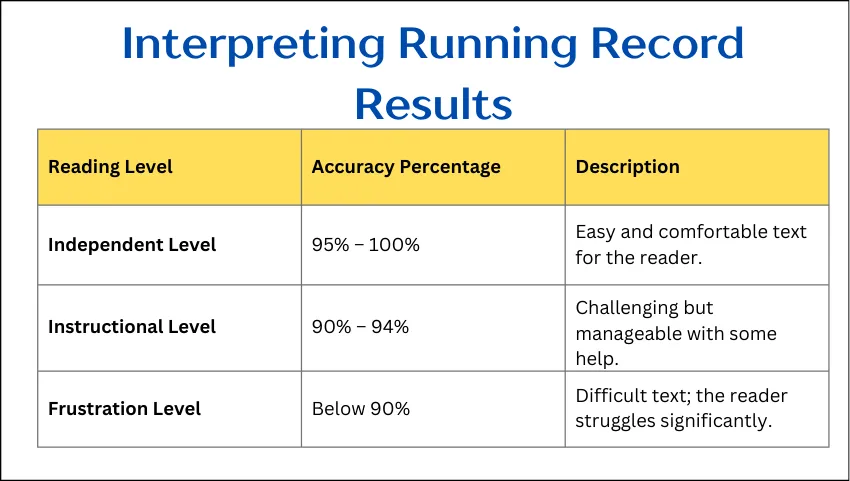
The following benchmarks help understand the different reading levels based on accuracy percentage:
| Reading Level | Accuracy Percentage | Description |
|---|---|---|
| Independent Level | 95% – 100% | Easy and comfortable text for the reader. |
| Instructional Level | 90% – 94% | Challenging but manageable with some help. |
| Frustration Level | Below 90% | Difficult text; the reader struggles significantly. |
If a student reads with 95% or higher accuracy, they are usually comfortable with the text and can work independently. Between 90-94%, the student is learning and can benefit from teacher support. Below 90%, the text is considered too hard, and instruction or easier materials should be provided.
Similarly, a self-correction ratio of around 1:5 or less indicates the student is actively monitoring their reading and correcting mistakes, an essential skill for developing fluent reading.
Why Accuracy, Error, and Self-Correction Matter
- Accuracy tells how well a student decodes the words straight from the text.
- Errors highlight where a student may struggle with phonics, vocabulary, or pronunciation.
- Self-corrections show metacognitive awareness—the student’s ability to recognize and repair mistakes, an important skill for independent reading.
Teachers can use this data to tailor individualized instruction and address specific weaknesses.
Benefits of Using a Running Record Calculator
Using an online or digital running record calculator has many advantages:
- Saves Time: Automatic calculations allow for quicker assessments.
- Consistency: Reduces human error and ensures consistent scoring.
- Easier Tracking: Many calculators store data for monitoring progress over time.
- Detailed Insights: Some calculators provide additional metrics like fluency and comprehension indicators.
Tips for Taking Effective Running Records
- Find a quiet environment where the student feels comfortable.
- Use a standardized marking system to note errors and corrections.
- Ensure the passage is appropriate for the reader’s current ability.
- Start and stop timing accurately to get reliable fluency data.
- Review the running record with the student to provide feedback and set goals.
Frequently Asked Questions
What is a running record calculator?
A running record calculator is an online tool or app that helps calculate reading accuracy, error rate, self-correction rate, and words per minute based on a running record assessment.
How do I use a running record calculator?
You enter the total words in the passage, the number of errors, self-corrections, and the reading time. The calculator then provides percentages and ratios for accuracy and reading speed.
Why is accuracy important in a running record?
Accuracy shows how many words the student read correctly and helps gauge if the reading level is too easy, just right, or too hard.
What is considered a good accuracy percentage?
An accuracy rate of 95% or higher means the text is at the student’s independent reading level, which is comfortable for them to read on their own.
Can I use a running record calculator for all grade levels?
Yes, running record calculators are useful for assessing readers of all ages and grades, from early learners to adults.
How long should the passage be for a running record?
Typically, passages range from 100 to 300 words to give enough data for assessment without tiring the reader.
Conclusion
In sum, a Running Record Calculator is an essential tool for educators and parents to measure, track, and improve student reading skills effectively. It simplifies the process of translating detailed reading observations into clear, actionable data such as accuracy, error rate, self-correction rate, and reading speed.
By regularly conducting running records and using calculators for quick assessment, educators can better understand their students’ reading abilities, tailor teaching strategies, and support students to become confident, fluent readers.