
AP US History Score Calculator
Calculate your estimated AP score based on your exam performance
Section I: Multiple Choice
Enter the number of questions you answered correctly
Section II: Short Answer Questions (SAQ)
Section II: Document-Based Question (DBQ)
Scored on a 7-point rubric
Section II: Long Essay Question (LEQ)
Scored on a 6-point rubric
An APUSH (AP US History) score calculator helps students estimate their potential or actual score on the AP US History exam before official results are released. Using such a tool gives peace of mind, helps with goal setting, and assists in planning study strategies for this challenging and crucial exam. This article explains in simple language what APUSH score calculators are, how they work, why they’re important, and how to use one effectively.
What Is the APUSH Score Calculator?
An APUSH score calculator is a simple, user-friendly web or spreadsheet tool that helps students predict their possible AP US History exam score based on their raw performance in different sections. You enter your correct answers or guesses for each part of the exam, and the calculator estimates your overall AP score, generally on the scale from 1 (lowest) to 5 (highest).
- Simple interface: Most calculators have basic input boxes for each exam section.
- Instant estimate: Results appear as soon as you fill in your data.
- Stress relief: You get a quick idea if you’re close to your target score.
How Does the APUSH Exam Work?
Knowing how the APUSH exam is structured is crucial before using a score calculator. The AP US History test consists of two main sections, each with multiple parts:
Section I
- Multiple Choice (MCQ):
- 55 questions
- 55 minutes
- Covers historical periods, themes, and content
- Short Answer Questions (SAQ):
- 3 questions
- 40 minutes in total
Section II
- Document-Based Question (DBQ):
- 1 essay
- 60 minutes (includes 15-min reading period)
- Long Essay Question (LEQ):
- 1 essay (choose from 3 options)
- 40 minutes to write
Each section carries different weight in the scoring process.
Why Use an APUSH Score Calculator?
Using a score calculator provides several benefits:
- Reduce stress: Eliminates uncertainty and gives you a probable score range.
- Study smarter: Pinpoints strengths and weaknesses by section.
- Set realistic targets: Helps you set goals for improvement before the real exam.
- Immediate feedback: Gives an idea of how changes in section performance impact your overall score.
How To Use the Calculator
A typical online APUSH score calculator is very straightforward. Here’s how to use it:
- Gather your responses: If it’s a practice exam, have your correct answers, essay scores, or estimate ready.
- Enter results:
- Input your MCQ score (number of correct answers)
- Enter your SAQ performance or points (often out of a set total)
- Fill in DBQ and LEQ raw or rubric scores
- Get instant results: The calculator will automatically show your estimated final AP score and whether you are likely to pass (a score of 3 or above is usually passing).
- Review feedback: Many calculators highlight which sections need improvement, letting you refocus your study efforts.
Tip: Try using your scores from several practice tests to see improvement over time.
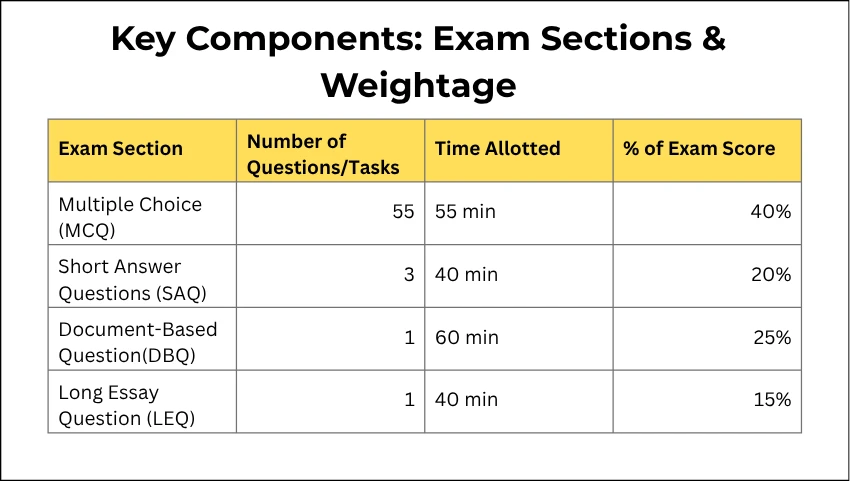
Key Components: Exam Sections & Weightage
Understanding each section’s importance allows for strategic preparation. Here’s how the test is broken down by points and impact:
| Exam Section | Number of Questions/Tasks | Time Allotted | % of Exam Score |
|---|---|---|---|
| Multiple Choice (MCQ) | 55 | 55 min | 40% |
| Short Answer Questions (SAQ) | 3 | 40 min | 20% |
| Document-Based Question(DBQ) | 1 | 60 min | 25% |
| Long Essay Question (LEQ) | 1 | 40 min | 15% |
Multiple Choice Questions (MCQ)
- Straightforward, fact-based or analytical questions.
- Each correct answer gives 1 raw point.
- 40% of your total exam weight.
Short Answer Questions (SAQ)
- Require brief written responses.
- Usually scored on a 0-3 or 0-4 scale each.
Document-Based Question (DBQ)
- Analyses historical documents and constructs an argument-based essay.
- Scored with a detailed rubric—often out of 7 points.
Long Essay Question (LEQ)
- One essay from three choices.
- Focuses on broader historical themes and arguments.
- Often scored out of 6 points.
Understanding Scoring: Raw Score To AP Score
The APUSH calculator translates your raw section scores into the final AP score (1-5). Here’s a step-by-step guide on how this happens:
1. Raw Scores
- MCQ: Each correct question is 1 point (max: 55).
- SAQ: Points per question, usually a total of 9.
- DBQ: Points out of 7.
- LEQ: Points out of 6.
2. Weightage Application
Each section’s points are converted into a percentage step depending on their exam.
Section Score = total possible points (raw points obtained × section weighting (%)
Example: If you got 33/55 MCQs, your MCQ percentage is 60% of the possible points.
3. Composite Score Calculation
The raw weighted section percentages are added together to produce a composite score, usually scaled up to 100 or 130 points depending on the system.
4. Scale to AP 1-5 Score
- Composite score is then matched with AP scoring boundaries, which are set each year by the College Board.
- Typical scale (for reference only):
- 5: 80-100%
- 4: 65-79%
- 3: 49-64%
- 2: 36-48%
- 1: below 35%
Please note actual score boundaries can change yearly and sometimes differ by a few points.
External link: See the AP US History Course and Exam Description (2024) for official College Board guidelines.
Interpreting Your Results
Once you have your estimated APUSH score, what does it mean?
- 5 = Extremely well qualified: Equivalent to an ‘A’ in college; most colleges grant credit.
- 4 = Well qualified: Good for college credit; shows solid knowledge.
- 3 = Qualified: Many colleges accept this, but some more selective ones do not.
- 2 = Possibly qualified: Borderline performance; not usually accepted for credit.
- 1 = No recommendation: Score suggests further study is needed.
Bold results are not guarantees but reasonable predictions based on historical data.
Tips To Improve Your APUSH Score
Score calculators reveal where you need work. Use the insight to improve your weak areas. Here are some top tips:
- Review previous mistakes: Focus on topics where you lost most points.
- Practice DBQs and LEQs: Writing skills are crucial for essays.
- Memorise key facts: MCQs heavily test factual recall.
- Take timed practice exams: Emulate real conditions to manage your time.
- Study with friends: Group studies can help explain difficult topics.
- Use official College Board sample questions for practice.
Frequently Asked Questions (FAQ)
What is an APUSH score calculator?
An APUSH score calculator is an online tool that estimates your likely score on the AP US History exam based on your performance in different sections of the test.
How accurate are APUSH score calculators?
They provide reasonable estimates based on past scoring trends but are not guaranteed since the College Board adjusts scoring curves each year.
Can I use an APUSH score calculator during the exam?
No, calculators are not allowed during the exam. The score calculator is meant for practice and prediction only.
How do I input my scores into an APUSH calculator?
You typically enter your raw scores or number of correct answers for multiple-choice, short-answer, DBQ, and long-essay sections.
Does the calculator give a final AP score from 1 to 5?
Yes, it converts your raw scores into the official AP score scale ranging from 1 (lowest) to 5 (highest).
Where can I find APUSH practice test answers for the calculator?
Official AP practice materials from College Board or trusted educational sites like Albert.io and Varsity Tutors provide answer keys.
Final Thoughts
An APUSH score calculator can be anxiety-reducing, motivating, and a great planning device for every AP US History student. By giving a clear snapshot of your current performance, it lets you focus study efforts and head into exam day with much more confidence. Remember, practice and honest self-assessment using these tools are the key to improvement.